
The short answer
You likely need a new AC if your system is aging, needs frequent repairs, or can't keep the house cool on hot valley days. We assess your home, ductwork and electrical, size the system to fit, and give you a written quote that compares central AC, heat pump and ductless options.
Installing a new central air conditioner or heat pump is a big decision for your home. In the west San Fernando Valley, summers run much hotter than in coastal neighborhoods, and fall Santa Ana winds can bring hot, dry spells late in the season. The system you choose has to keep up with both. Breezanta HVAC Repair Service installs AC systems for homeowners in Canoga Park, Winnetka, West Hills, Woodland Hills, Reseda, Chatsworth and nearby areas. This page covers when a new system makes sense, what we check before recommending equipment, your main options, what drives the cost, and what happens during a visit.
Signs It May Be Time for a New AC
Not every struggling system needs to be replaced. Some patterns, though, point toward installation rather than another repair.
If any of these sound familiar, a site visit will show whether a repair still makes sense or whether new equipment is the better use of your money.
- The system is older and needs repairs more than once a season
- A major component, such as the compressor or outdoor coil, has failed
- Rooms stay warm even though the system runs for long stretches
- Summer electric bills keep climbing even though you use the house the same way
- The unit uses an older refrigerant that is getting harder and more costly to service
- You're adding square footage or converting a garage, or the home has never had central air
- You want to replace a gas furnace and AC with an all-electric heat pump
What We Check Before Recommending a System
A new air conditioner only performs as well as the house and ductwork around it. Before we suggest a size or model, we look at the whole setup.
We size equipment to your home instead of matching whatever was there before. An oversized unit cycles on and off quickly and leaves rooms feeling clammy. An undersized one runs nonstop on the hottest valley afternoons and still falls behind.
- Home size, layout, ceiling heights, sun exposure through windows, and insulation, which together determine how much cooling you need
- Condition, sizing and sealing of existing ductwork, including leaks in the attic or crawlspace
- Return air paths and how evenly air reaches each room
- Electrical panel capacity and the circuit that feeds the outdoor unit
- Space and clearance for the outdoor condenser and the indoor furnace or air handler
- Thermostat compatibility and wiring
- Condensate drainage
Repair, Replace or Upgrade: Your Options
Installation isn't a single choice. Depending on what we find, these are the most common paths.
If your furnace is also near the end of its life, keep one regulation in mind. South Coast AQMD Rule 1111 limits nitrogen oxide emissions from natural-gas central furnaces sold and installed in our region, and the district has been amending the rule toward zero-emission requirements. The district sets and revises the compliance dates, so we check the current rule with you before planning a furnace replacement. For many homeowners, that makes a heat pump worth comparing.
Rebates depend on which utility serves your address. If LADWP provides your electricity, its Consumer Rebate Program offers rebates to residential customers on qualifying heat pump systems, with the amount based on the unit's SEER2 and HSPF2 ratings. You apply after the equipment is purchased and installed, within 12 months of purchase. Many homes outside the City of Los Angeles are served by Southern California Edison instead, which has different offers, so we confirm what applies to your home before including it in a quote. The federal 25C tax credit only covered qualifying heat pumps placed in service before December 31, 2025, and it isn't available for new installations.
- Repair the existing system if the problem is isolated and the equipment still has useful life
- Replace the outdoor unit and indoor coil as a matched set and keep a furnace that's in good condition
- Replace the full system, including the furnace or air handler
- Install a heat pump that handles both cooling and heating with electricity
- Add ductless mini-splits for additions, converted garages or rooms the ducts don't reach
What Affects the Cost of a New System
We don't quote installations over the phone because every home is different. These are the main factors that shape the price.
You'll get a written quote that lists the equipment and the work included, so you can compare options side by side.
- System type: central split AC, heat pump, packaged unit or ductless
- The capacity your home needs based on its size and heat load
- Efficiency rating, measured as SEER2 for cooling and HSPF2 for heat pump heating
- Whether ductwork can be reused, needs sealing and repair, or must be replaced
- Electrical work, such as a new circuit or panel upgrade
- How easy it is to reach the attic, roof or crawlspace where equipment and ducts sit
- Permits and inspections required by the local building department
- Extras such as a new thermostat, upgraded air filtration or a new equipment pad
How an Installation Visit Works
First, we schedule an in-home assessment. A technician walks through the house, checks the existing equipment, ducts and electrical, and asks how the house feels in summer: which rooms run hot, how long the system runs, and anything else that has bothered you.
Next, we review your options and give you a written quote. If you have questions about efficiency levels or rebate eligibility, we'll answer them before you decide.
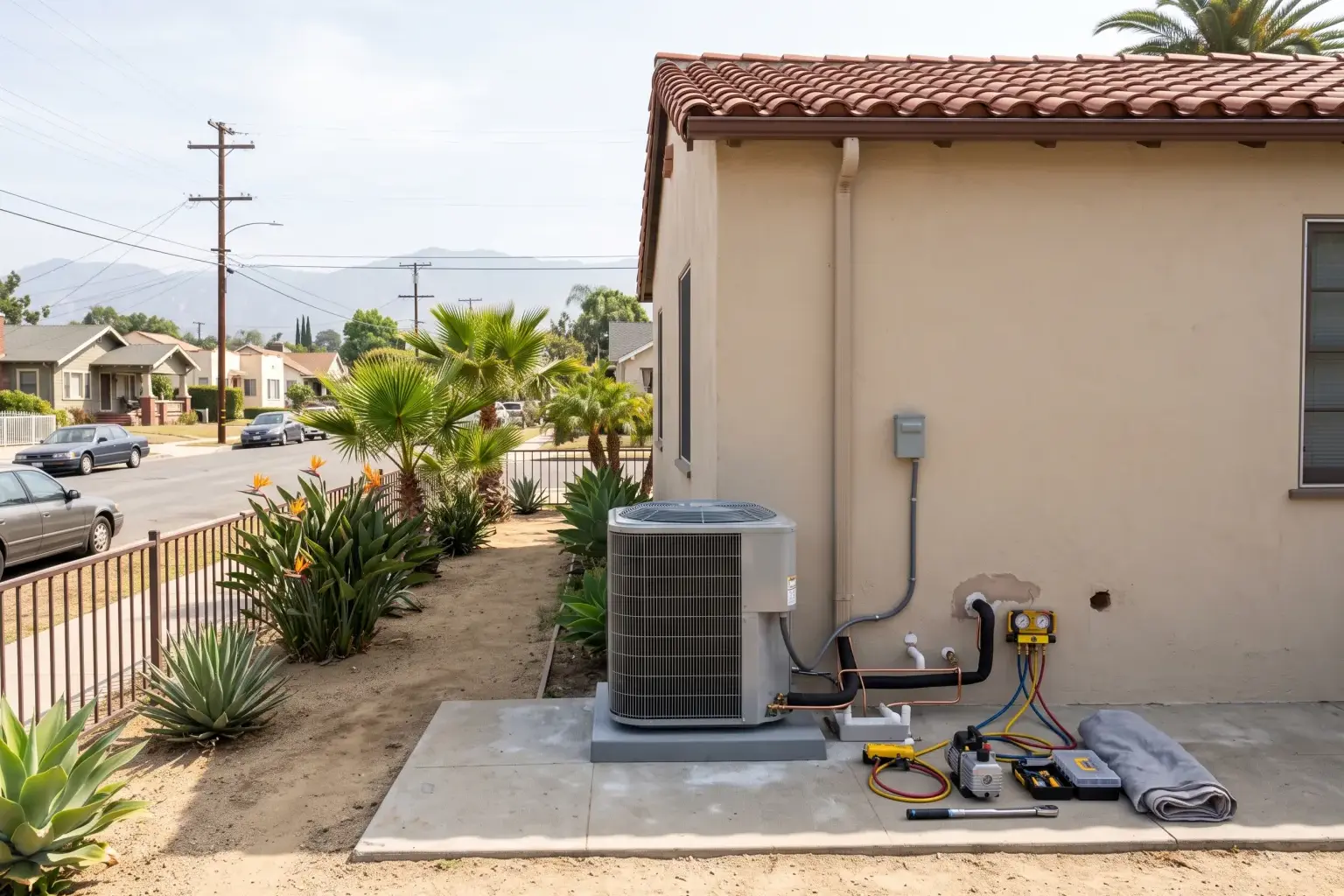
On installation day, the crew protects floors and work areas, recovers refrigerant from the old equipment and removes it, sets the new indoor and outdoor units, and connects the refrigerant lines and electrical. We also make any duct changes. Then we evacuate and charge the system, test airflow and temperatures, and confirm the thermostat works correctly.
Before we leave, we show you the controls, where the filter is, and what basic upkeep looks like. Where a permit inspection is required, we arrange it.
AC Installation by city
- AC Installation in Hidden Hills
- AC Installation in Calabasas
- AC Installation in Simi Valley
- AC Installation in Agoura Hills
- AC Installation in San Fernando
- AC Installation in Westlake Village
- AC Installation in Santa Monica
- AC Installation in Malibu
- AC Installation in Beverly Hills
- AC Installation in Thousand Oaks
- AC Installation in West Hollywood
- AC Installation in Moorpark