
The short answer
Indoor air quality service finds out why your home has dust, odors, stuffiness, or humidity problems and fixes the HVAC-related causes. We inspect filtration, ductwork, coils, airflow, and ventilation, then recommend a repair, an upgrade, or a replacement based on what we find.
Homes in Canoga Park and nearby areas like Winnetka, West Hills, Reseda, Woodland Hills, and Chatsworth stay closed up for long stretches. The AC runs through hot valley summers, and windows stay shut when fall Santa Ana winds bring dust and dry air. Your heating and cooling system moves the air in your home many times a day, so it has a big effect on what you breathe. When filters, ducts, coils, or ventilation aren't doing their job, you notice dust, odors, stuffiness, or allergy flare-ups. Our indoor air quality service looks at how your HVAC system is affecting your air and fixes the parts that are falling short.
Signs Your Home's Air Needs Attention
Air quality problems usually build up slowly, so they're easy to get used to. If several of these sound familiar, have your system checked. A small issue like a gap around the filter, a disconnected duct, or a dirty coil is often behind them.
In the valley, the problems tend to show up after summer, when the AC has run hard for months, and after windy fall spells that push fine dust into attics and duct systems.
- Dust builds up on furniture within a day or two of cleaning
- Musty, sour, or burning smells when the system turns on
- Allergy or sinus symptoms that ease when you leave the house
- Rooms that feel stuffy or stale even with the system running
- Visible dirt or dark streaks around supply vents
- Air that feels very dry in winter or clammy in summer
- Filters that clog much faster than they used to
- A gas furnace that produces soot, a yellow flame, or a headache-type feeling indoors (turn it off and call right away)
What We Check
We start with your concerns, because the symptoms point us toward likely causes. Then we inspect the parts of the HVAC system that affect the air in your home. We don't guess or sell a gadget before we know what's going on. We trace the problem back to its source.
If something we find is a safety issue, such as signs of a cracked heat exchanger or poor venting on a gas furnace, we tell you right away and explain your options before we do anything else.
- Filter size, fit, and rating, and whether air is bypassing the filter
- Return and supply ducts for leaks, disconnections, crushed runs, and debris, especially in the attic
- Evaporator coil and drain pan for dirt, standing water, or microbial growth
- Blower wheel and motor condition, since a dirty blower spreads dust and cuts airflow
- Airflow and static pressure, to see if the system is starved for air
- Ventilation and how the house brings in outside air
- Humidity levels and how the system handles moisture
- Combustion and venting on gas furnaces
Repair, Upgrade, or Replace
Most air quality problems can be fixed without new equipment. Sealing a leaky return duct in a dusty attic, cleaning a coil, fixing a drain that holds water, or fitting a better filter cabinet often makes a clear difference. We always start with the simplest fix that addresses the cause.
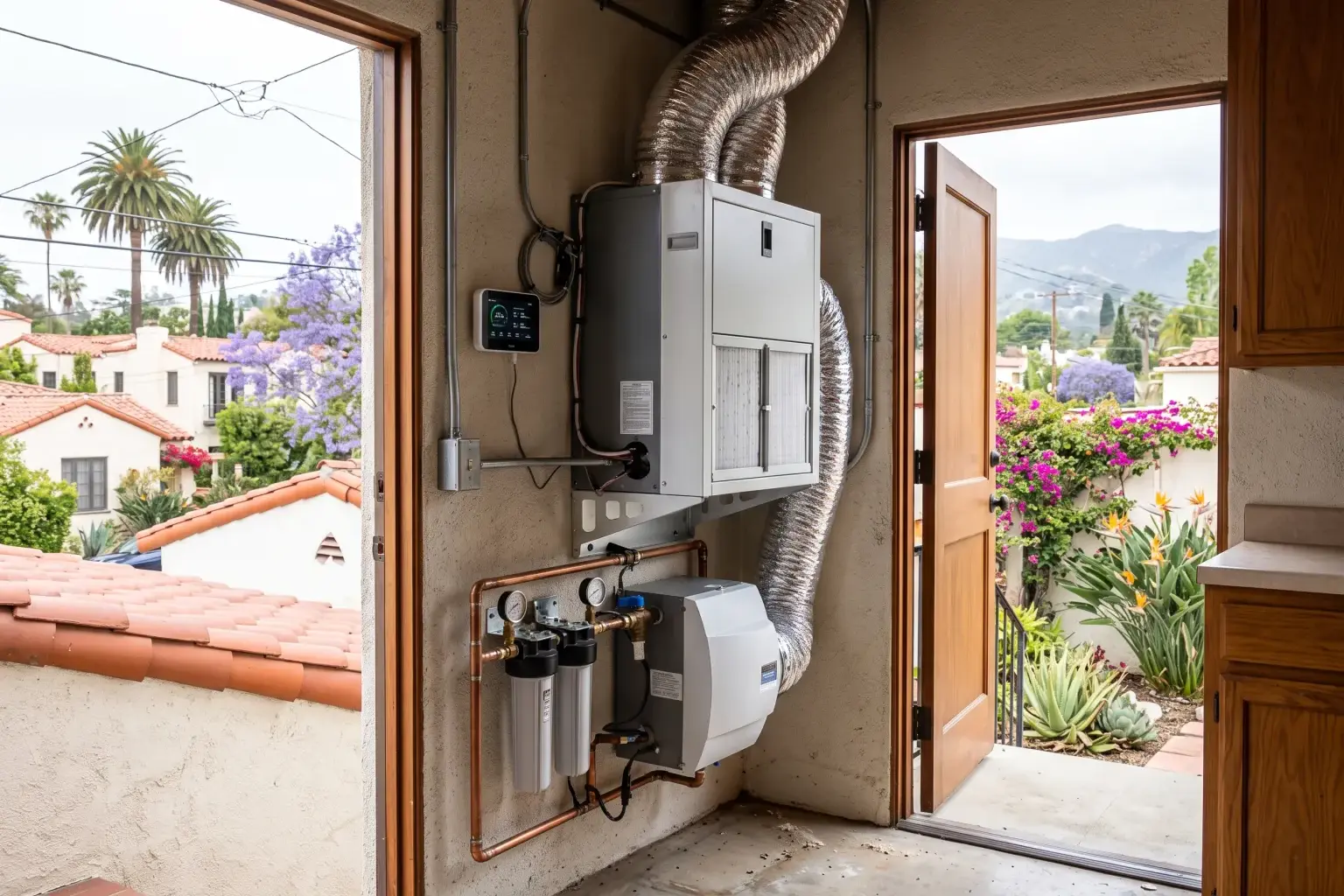
When repairs aren't enough, we may suggest an upgrade. That could mean a media filter cabinet, an air purification add-on, a fresh-air ventilation system, or a humidifier for dry winter months. We only recommend add-ons that fit your home, your system's airflow, and the problem you're trying to solve. A high-rated filter on a system that can't handle it can make things worse.
Sometimes the equipment itself is the problem. An aging furnace with a damaged heat exchanger, or a system with badly deteriorated ductwork, may be better replaced than patched. If you're considering a new gas furnace, South Coast AQMD Rule 1111 limits furnace emissions in the Los Angeles region, and the district has been moving the rule toward zero-emission requirements. We'll check the current compliance dates with you. A heat pump is another option. LADWP customers may qualify for a rebate based on the unit's efficiency ratings, but some nearby homes are served by Southern California Edison instead, so we confirm which offer applies to your address before quoting it. The federal 25C tax credit for heat pumps no longer applies to new installations.
What Affects the Cost
Every home is different, so we give you a clear quote after the inspection rather than a guess over the phone. These are the main factors that shape the price:
- What's causing the problem and how many issues we find
- Attic access and how hard it is to reach ducts and equipment
- Duct condition and how much sealing, repair, or replacement is needed
- The type of filtration, purification, or ventilation equipment you choose
- Whether your system needs modifications to support an add-on
- The age and condition of your furnace, air handler, or heat pump
- Whether any work requires permits or rule compliance
How a Visit Works
When you contact us, we'll ask what you're noticing and when it started. That helps the technician come prepared. At your home, we walk through the symptoms with you, then inspect the system from the filter and returns through the equipment, coil, and ductwork.
Afterward, we explain what we found in plain terms and show you photos when that helps, especially for attic ducts you can't easily see yourself. You'll get your options, from basic fixes to upgrades, along with what each one is meant to solve. Nothing moves forward until you approve it. Once the work is done, we recheck airflow and system operation and let you know how often to change filters and what to watch for going forward.