
The short answer
A ductless mini-split is a good fit when certain rooms stay too hot or cold, when you've added space without ductwork, or when adding ducts would be costly and disruptive. We size the system to your rooms, check your electrical and mounting options, and explain repair, upgrade, and replacement choices before any work begins.
A ductless mini-split delivers cooling and heating directly to the rooms you use, without running ductwork through the attic or walls. In Canoga Park and the West San Fernando Valley, that often means a hot back bedroom, a converted garage, or a room addition can finally stay comfortable through summer. We install single-zone and multi-zone systems. We also evaluate existing mini-splits that are struggling, so you can decide whether a repair, a partial upgrade, or a new system makes the most sense. Here is what to expect, from the first conversation to the final startup.
Signs a Mini-Split Makes Sense for Your Home
Inland valleys run much hotter in summer than neighborhoods near the coast, and fall Santa Ana winds can bring hot, dry spells late in the year. Rooms at the end of a long duct run, rooms over a garage, and additions that were never tied into the central system usually feel those swings first. A mini-split can solve these problems without reworking the whole house.
These are the situations where homeowners most often call us:
- One or two rooms stay noticeably hotter or colder than the rest of the house
- You added a room, converted a garage, or built an accessory dwelling unit that has no ductwork
- Your home has no central air, and adding ducts would mean major attic or wall work
- Window units or portable ACs are noisy, block light, or can't keep up on hot afternoons
- You want to cool only the rooms in use instead of the whole house
- An existing mini-split is short-cycling, blowing warm air, leaking water indoors, or making new noises
What We Check Before Recommending a System
A good mini-split installation starts with the room, not the equipment catalog. We look at how the space gains and loses heat, then size the indoor units to match. An oversized unit cools quickly but cycles on and off and can leave a room feeling clammy. An undersized unit runs nonstop on the hottest days and still falls short.
If you already have a mini-split, we test it before talking about replacement. Many problems trace back to dirty filters, a clogged condensate line, or a refrigerant leak at a fitting rather than a failed compressor.
On every visit, we check:
- Room size, ceiling height, window exposure, and insulation
- Where each indoor unit can mount for even airflow and easy filter access
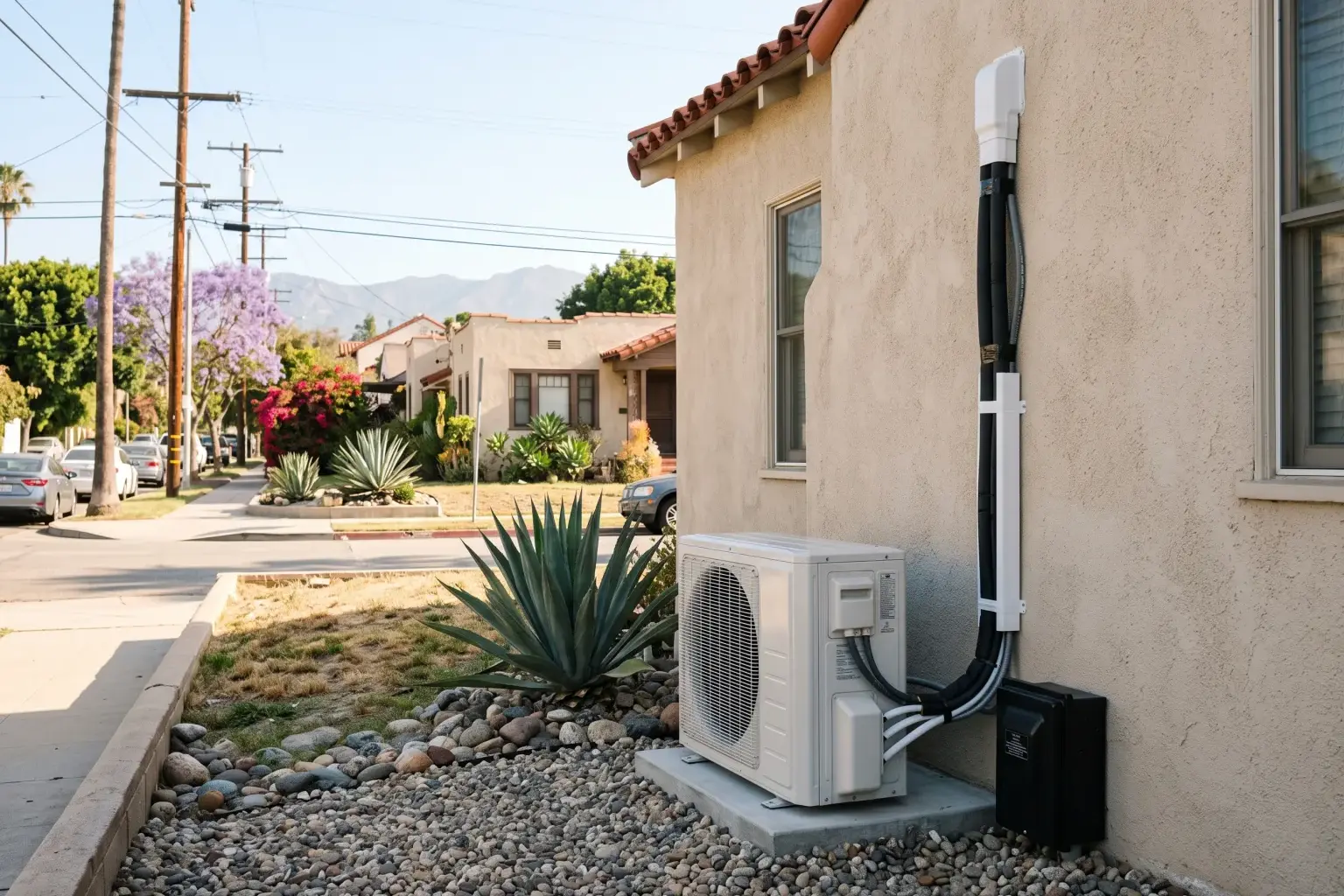
- Outdoor unit placement, including clearance, drainage, sun exposure, and noise toward neighbors
- The route and length of the refrigerant lines between the indoor and outdoor units
- Electrical panel capacity and whether a new dedicated circuit is needed
- The condensate drain path, so water leaves the house cleanly
- For existing systems: refrigerant charge, coil condition, fan motors, drain lines, and error codes
Repair, Upgrade, or Replace
When an existing mini-split is the problem, we lay out your options side by side. Repair usually makes sense when the system is relatively young, parts are available, and the problem is isolated, such as a failed sensor, a clogged drain, or a worn fan motor. Replacement makes more sense when refrigerant leaks keep coming back, the compressor has failed on an older unit, or parts are hard to find.
There is often a middle path as well. If one zone of a multi-zone system needs work, or you want to add another room, we check whether your current outdoor unit has enough capacity to support it before recommending new equipment.
If you are replacing a gas furnace and considering a heat pump mini-split instead, regional rules matter. South Coast AQMD Rule 1111 limits NOx emissions from gas furnaces sold and installed in the Los Angeles region, and the district has been amending it toward zero-emission requirements. Because the district sets and revises the compliance dates, check the current rule before you decide.
What Affects the Cost
We don't quote a price until we've seen the space, because several factors change the total:
Rebates can offset part of the cost. LADWP residential electric customers can apply for Consumer Rebate Program rebates on qualifying heat pump systems, and the amount depends on the unit's SEER2/HSPF2 rating. You file the application after the equipment is purchased and installed, within 12 months of purchase. Many homes outside the City of Los Angeles are served by Southern California Edison instead, so the rebates available to you depend on which utility serves your address. We confirm the current offer before including it in a quote. The federal 25C tax credit covered qualifying heat pumps placed in service before December 31, 2025, so it does not apply to new installations.
- Number of zones and indoor units
- Capacity and efficiency rating (SEER2/HSPF2) of the equipment
- Indoor unit style: wall-mounted, ceiling cassette, floor console, or concealed ducted
- Length of the refrigerant lines and how hard the route is through walls, attics, or crawlspaces
- Electrical work, including new circuits or panel upgrades
- Outdoor unit mounting, such as a ground pad, wall bracket, or stand
- Line covers, patching, and other finish work
How a Visit Works
We keep the process simple and explain each step before we start. Here is how it usually goes:
Single-zone installations generally take less time than multi-zone jobs. We'll tell you what to expect for your home when we present your options.
- Walkthrough: we talk about which rooms are uncomfortable and how you use them
- Measurements and checks: we look at room loads, mounting spots, the electrical panel, and the refrigerant line route
- Written options: we lay out equipment choices and placement, with rebate notes for your utility
- Installation: we mount the indoor and outdoor units, run the refrigerant lines and drain, complete the wiring, pressure-test and vacuum the lines, then charge the system and start it up
- Handoff: we show you the remote, the operating modes, the scheduling features, and how to clean the filters